CLIMATE INTELLIGENCE FOR LOGISTICS
Climate risk in logistics isn't an unforeseen event. It's demurrage, detention and blown SLAs
Every logistics operation today has a transport management system, a warehouse management system, an ERP, a control tower and a vessel tracker, each with a dedicated team, KPI and SLA. Climate risk, the one that most delays pickups, closes bars, stops cabotage and triggers demurrage, is still treated as an unforeseen event. Not as a management variable.
Cabotage, deep sea, road and last mile: weather goes into the decision, not into the excuse for the delay.







Climate risk is already the biggest invisible bottleneck in the Brazilian logistics chain
US$ 2.3 billion
in demurrage in Brazil in 2024, up 15% from 2023. Vessel demurrage that lands on the cash flow of the shipper, the importer and the freight forwarder. Weather is one of the root causes.
374 blockages
on federal highways caused by weather events in 2023, nearly 8 times more than in 2018, when there were 61. In 2024, weather events became the 2nd leading cause of federal highway interruptions. A stopped truck is a lost pickup, a lost port window and a disconnected cabotage leg.
R$ 1.4 billion
in extra logistics costs for the Manaus Free Trade Zone industry during the 2023 Amazon drought, when cargo ships went more than 50 days without supplying Manaus. When the draft disappears, cargo migrates to the more expensive route and freight rates go up.
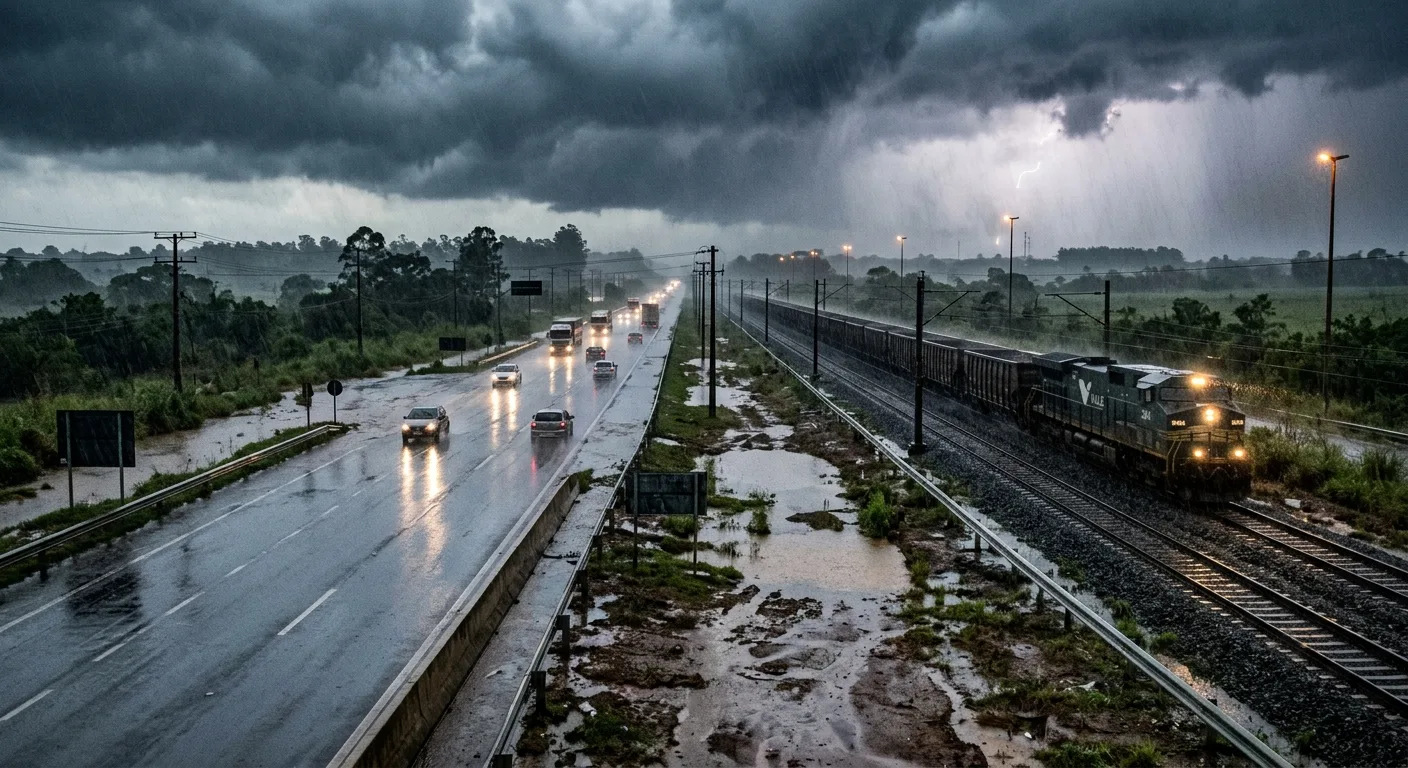
A truck stuck in a flood, a railway blocked by a landslide, a port closed by fog, river navigation halted by drought, the last mile interrupted by torrential rain. At every link, the decision came after the event.
A climate copilot that sees the entire chain, from the shipper's yard to the final destination
A conversation in the channels your team already uses
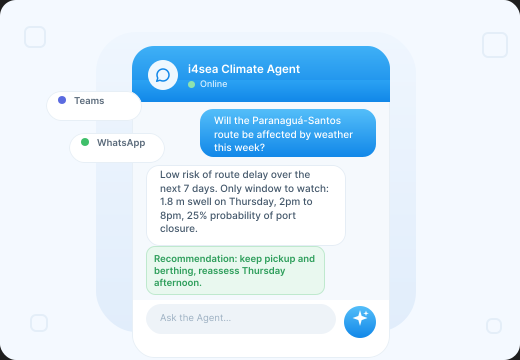
The AI Climate Agent lives in WhatsApp, Teams and a ChatGPT-style chat. Your team asks "what are the weather impacts on the ports this week?", "will rain stop pickups at the transshipment yard on Tuesday?", "will the Paranaguá-Santos route be affected?". The Agent replies with the window, the recommendation and who needs to be notified. And when a risk appears, the Agent arrives first, without anyone having to ask. It doesn't replace your transport management system. It goes inside it.
- Teams
- Chat
- Natural language
- Proactivity
Visibility across the entire chain, door to port and door to door
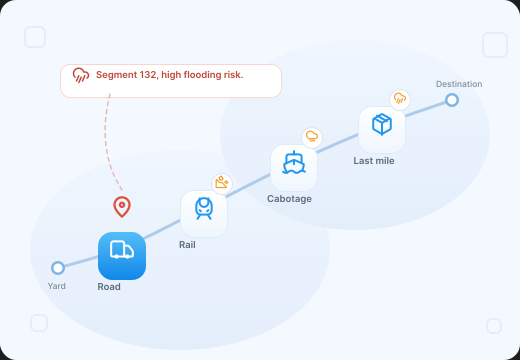
A truck on the highway, a railcar on the railway, a container in the yard, a ship on the cabotage leg, a courier on the last mile. Each link receives specific operational windows (loading, berthing, passage through a critical mountain stretch, river draft, risk score per port, landslides on railways). It's not "weather in the Southeast". It's "stretch 132 of BR-101, high flood risk between 4 AM and 10 AM, trigger the detour".
- Cabotage
- Road
- Rail
- Last mile
- Per link in the chain
An auditable trail for force majeure, demurrage and insurance
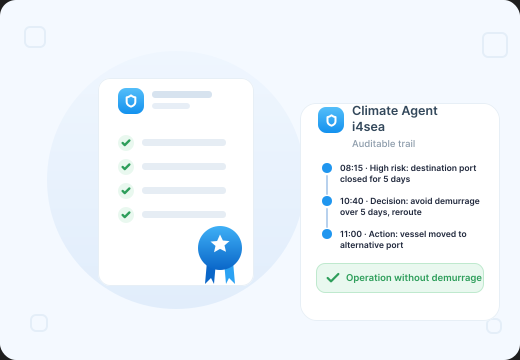
Every alert and decision is logged with time, data source and owner. When the ship waits at anchorage, the truck gets stuck in a flood or torrential rain shuts down the avenue, your operation has the evidence ready to support the demurrage claim and the detention waiver, contest the SLA penalty and back the cargo insurance claim. Leave force majeure behind and move to here is the evidence.
- Auditable trail
- Demurrage
- Detention
- Force majeure
- Cargo insurance
Get a climate exposure assessment before the next impact
Want to see how it would look across your chain?
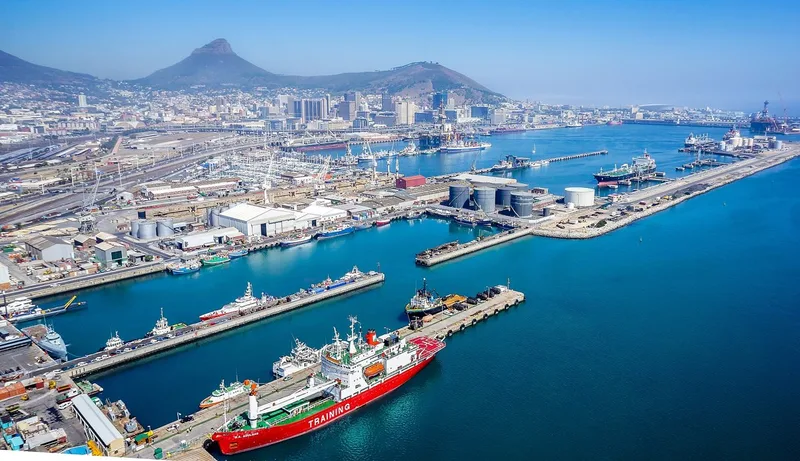
Cabotage operation
(client under confidentiality)
The result when the decision comes before the event
15%
reduction in storage and cargo roll-over
With an integrated view and up to 90 days of lead time, the operation began deciding on better windows and detours. The gain showed up in cash: a 15% reduction in storage and roll-over costs, while adding more cargo and optimizing planning between ports.
Climate risk in logistics: frequently asked questions
Get a climate exposure assessment before the next impact
You can't control the weather, but you must manage the risks
Weather disrupts each link differently: rain and flooding paralyze highways and interrupt deliveries; fog, wind and sea state close ports and increase vessel waiting time; storm surge and cyclones divert deep-sea routes; a flooded yard freezes transshipment and the last mile. The effect propagates: one delayed link pushes demurrage, detention and SLA penalties onto the next. That's why the risk needs to be read per link and ahead of time, not as a "regional forecast".
No. Anticipating bad weather and climate risks is what reduces demurrage. Logistics teams that anticipate port restrictions with up to 10 days of lead time optimize planning and define alternative ports. Depending on the contract (laytime clauses), the evidence can make the discussion easier. i4sea delivers the auditable trail of risks and actions taken to support your claim. For context: in 2024, Brazil accumulated US$ 2.3 billion in demurrage, and weather is one of the root causes.
A weather forecast answers "what will the weather be like". Climate intelligence answers "what to do in your operation": it translates the data into risk per link, a decision window and a recommendation, with an auditable trail, at a hyperlocal resolution of 1 to 3 km per route and berth, not a bulletin per region. See the full comparison on our blog: Climate intelligence versus weather forecasting.
Each link is registered as a monitored asset, with its own geometry, route and operational limits: landslides that close the highway, flooding that covers the track bed on the railway, fog that creates waiting time for cabotage, rain that makes last-mile delivery unfeasible. The Agent doesn't answer by state or region. It answers by stretch, berth, route and window. The decision arrives at the level where it's actually made.
It depends on the phenomenon and what it affects:
- Imminent lightning: minutes up to 6 hours
- Wind, gusts and heavy rain: hours to 2 days
- Accumulated rainfall, soil saturation and cabotage windows: 1 to 3 days
- Cold fronts, extratropical cyclones and storm surge: 3 to 10 days
- River levels, draft and navigability: up to 90 days
- Route seasonality (monsoon period, fog season, El Niño): weeks to months
Each link gets the lead time it needs to act, not whatever is left over from the bulletin.
The Agent lives in WhatsApp, Teams and a ChatGPT-style chat. The logistics manager asks "what are the weather impacts on the ports this week?", "will rain stop pickups at the transshipment yard on Tuesday?", "will the Paranaguá-Santos route be affected?" and receives the window, the recommendation and who needs to be notified. And when a risk appears, the Agent arrives first, without anyone having to ask. It's proactive initiative in the channel the team already opens every day, not one more portal to log into.
Two ways: integration with the transport management system, the control tower or the vessel tracker (via technical channels configured during onboarding), or through the human channel, with the Agent talking to operations, planning and commercial teams on Teams and WhatsApp. Every weather delay is logged and linked to the corresponding link, route and cargo, with time, data source and owner. At the end of the month, the system knows exactly what the weather took from the SLA.
Every alert and decision is logged with time, data source and owner. When the ship anchored waiting for the bar to open or the truck got stuck in a flood, your operation opens the trail and has in hand the forecast event, the observed event, the recommendation sent and who decided what. Evidence ready to support the demurrage claim and the detention waiver, contest the SLA penalty and back the cargo insurance claim, with nothing to reconstruct afterwards.
All three run on the same Agent, with different rules, because each one's risk is different. Shipping: berthing windows per port, storm surge and groundswell along the coast, fog at the bar, risk score per port. Multimodal: landslides, flooding and fog on the road leg, trees falling on the track, fire and flooding on the rail leg, torrential rain on the last mile. When a risk to a link is identified, the Agent alerts the people responsible, with knowledge of your operation.
A few weeks, in 3 stages:
1. Mapping of the chain's critical links (road and rail routes, ports and berths, cabotage and deep-sea routes, transshipment yards, last-mile areas) with operational limits
2. Calibration with the operation's history and contractual clauses (SLA penalties, free time periods, contractual and insurance force majeure hypotheses)
3. Configuration of channels (WhatsApp, Teams, email), alert levels and notification protocols per link
It involves operations, commercial, legal and, where applicable, the control tower. It gets off the ground fast, because the next bomb cyclone won't wait for onboarding to finish.
Four differences that matter in logistics:
- Resolution: public forecasts operate at a scale of tens of kilometers and can't tell one stretch of the route from another. i4sea delivers 1 to 3 km per link in the chain.
- Language: a generic rain bulletin versus an actionable recommendation per route, berth, railcar and pickup window.
- Initiative: with traditional forecasts, the team checks when they remember. Here, the Agent warns first, without anyone having to ask.
- Auditable trail: a bulletin doesn't become demurrage evidence or an insurance report. Every i4sea alert does.
A bulletin reports the weather. The Agent protects the operation's margin.
A ship stopped at the Port of Santos costs from US$ 20,000 to US$ 50,000 per hour. A container on demurrage at a Brazilian port racks up hundreds of dollars per day, and a truck immobilized for a day removes an entire trip from the network. The Agent costs a fraction of that. It pays for itself on the first anticipated event, and from then on everything it avoids is margin going back into the operation.